
Have you ever wondered how much work takes place behind the scenes to keep a school running smoothly? Teaching is just one part of the process. Administrators also manage attendance, fee payments, exam records, timetables, payroll, and communication with parents. When these tasks are handled through paperwork or scattered spreadsheets, it often leads to confusion, errors, and wasted time for staff.
Fortunately, technology is simplifying school operations. A modern school management system brings all essential tasks into one centralized platform. Teachers can take attendance in seconds, administrators can track fees and reports effortlessly, and parents can keep up with their child’s progress without needing constant communication with the school.
With the rise of the SaaS model, schools can now access cloud-based software through affordable subscriptions, creating new opportunities for entrepreneurs to build scalable platforms and generate recurring revenue.
Understanding the SaaS Model in Education
Before starting your business, it’s important to understand how the SaaS model works and why it is ideal for educational software.
What is SaaS?
SaaS stands for Software as a Service, a cloud-based software delivery model where users access applications through the internet rather than installing them locally.
Instead of purchasing a software license, customers pay a monthly or yearly subscription to access the platform.
For schools, this approach offers several advantages:
-
No complex installation
-
Automatic updates
-
Access from any device
-
Lower upfront costs
-
Scalable features
Because schools rely on the software daily, they are willing to pay recurring subscription fees. This creates a stable and predictable revenue stream for the SaaS provider.
If you use a school management system SaaS source code, you can launch your own platform where multiple schools subscribe to your service.
This model creates predictable and recurring revenue while providing continuous value to schools.
From Idea to Launch: Steps to Create a School Management SaaS Platform
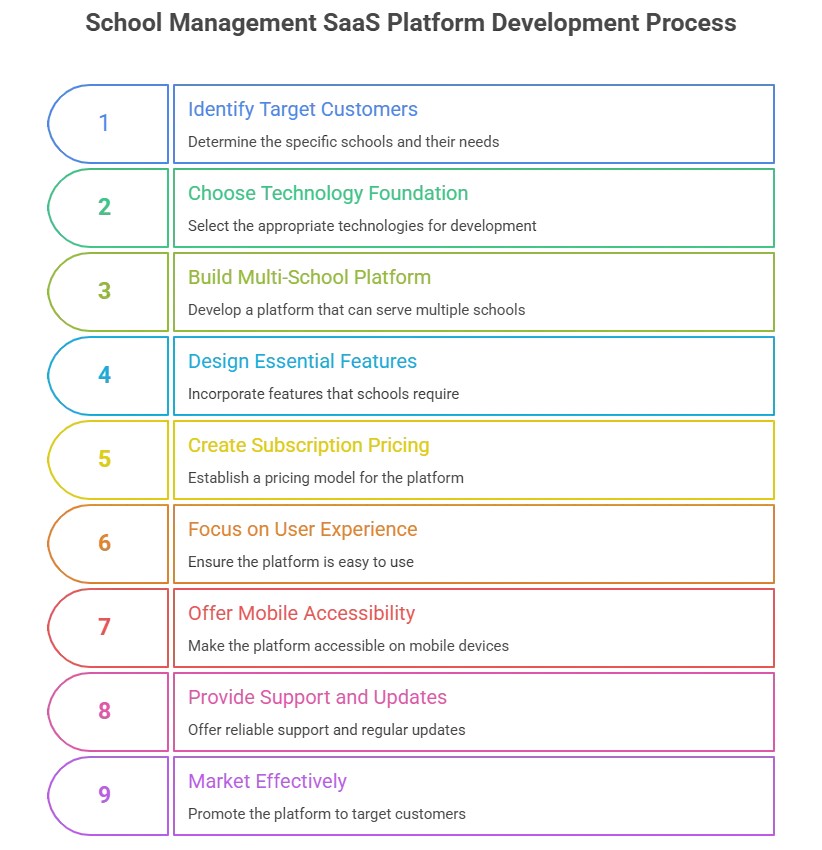
Step 1: Identify Your Target Customers
Before building your platform, identify the type of institutions you want to serve.
Your potential customers may include:
-
Small private schools
-
Large educational institutions
-
Coaching centers
-
International schools
-
School chains and academies
Each segment has different needs.
For example:
A small school may only require basic features such as attendance tracking and fee management.
A large institution may require advanced tools like analytics dashboards, multi-branch management, and role-based access.
If your platform is built using a multi school management system code, you can serve multiple institutions from a single platform while maintaining separate data for each school.
This makes your business scalable and efficient.
Step 2: Choose the Right Technology Foundation
Building a SaaS platform from scratch can be expensive and time-consuming.
A smarter approach is to start with a ready-made solution that already includes essential modules.
Using a school ERP SaaS source code can significantly reduce development time and cost. Rather than spending months developing core features, you can concentrate on customizing, branding, and expanding your platform.
A complete school ERP platform typically includes:
-
Student admission management
-
Attendance tracking
-
Fee management
-
Examination and grading systems
-
Staff and payroll management
-
Communication tools
-
Timetable scheduling
-
Reports and analytics
Having these features ready allows you to launch faster and start acquiring customers quickly.
Step 3: Build a Multi-School SaaS Platform
One of the most important aspects of a SaaS business is scalability.
Instead of selling software separately to each school, your platform should allow multiple institutions to operate within a single system.
This approach offers several benefits:
-
Lower operational costs
-
Centralized updates
-
Easier customer onboarding
-
Efficient server management
A multi school management system code enables you to create separate dashboards for different schools while managing everything from a single admin panel.
Each school can have its own:
-
Teachers
-
Students
-
Classes
-
Fees
-
Reports
-
Communication system
Meanwhile, you maintain control of the entire platform.
Step 4: Design Essential Features Schools Need
To build a successful SaaS platform, your software must solve real problems faced by schools. Some must-have features include:
1. Student Information Management
Schools require a centralized system to store and manage student records efficiently.
This includes:
-
Admission details
-
Academic history
-
Attendance records
-
Contact information
2. Fee Management
Manual fee tracking often causes errors and delays.
Automated fee systems allow schools to:
-
Generate invoices
-
Track payments
-
Send reminders
-
Manage online payments
3. Attendance Tracking
Digital attendance helps teachers quickly mark and track student presence.
Parents can receive real-time notifications.
4. Examination and Results
Schools need tools to create exams, record marks, and generate report cards automatically.
5. Parent Communication
Communication is one of the biggest challenges for schools.
Your platform should include:
-
Notifications
-
Messaging systems
-
Announcements
-
Event updates
These features can all be implemented using a reliable online school management software script, ensuring smooth operation for schools.
Step 5: Create a Subscription-Based Pricing Model
A recurring revenue model is the foundation of a successful SaaS business.
Instead of charging schools a one-time fee, you can offer subscription plans such as:
1. Monthly Plans
Schools pay a fixed amount every month.
2. Annual Plans
Schools pay once per year with a discount.
3. Tiered Pricing
Different pricing levels based on features and the number of students.
Basic Plan
-
Student management
-
Attendance system
Professional Plan
-
Fee management
-
Examination tools
-
Parent communication
Enterprise Plan
-
Multi-branch management
-
Advanced reports
-
Custom integrations
If your platform is built using a school management system SaaS source code, implementing subscription plans becomes much easier.
Step 6: Focus on User Experience
Even powerful software will fail if it’s difficult to use.
School staff may not always be highly technical, so the platform must be simple and intuitive.
Important design principles include:
-
Clean dashboard layout
-
Easy navigation
-
Mobile-friendly interface
-
Fast loading speeds
-
Clear reports and analytics
A well-designed interface encourages schools to adopt the system quickly and continue their subscriptions.
Step 7: Offer Mobile Accessibility
Today, most users rely on smartphones.
Teachers, parents, and students expect mobile access to school systems.
Your SaaS platform should support:
-
Mobile dashboards
-
Parent apps
-
Teacher portals
-
Notification alerts
Solutions like eSchool SaaS demonstrate how mobile-friendly platforms improve communication between schools and parents.
Real-time updates, attendance notifications, and exam alerts can all be accessed from mobile devices.
This significantly improves user engagement.
Step 8: Provide Reliable Support and Updates
SaaS businesses succeed when customers stay subscribed for long periods.
To ensure customer retention, provide:
-
Technical support
-
Regular feature updates
-
Security improvements
-
Training resources
Schools rely heavily on management systems, so reliability is critical.
Continuous improvements also help your platform remain competitive in the market.
Step 9: Market Your SaaS Platform Effectively
After building your platform, the next step is attracting schools.
Some effective marketing strategies include:
-
Content Marketing: Write blogs showing how technology improves school management.
-
Free Trials: Allow schools to explore platform features before subscribing.
-
Demo Sessions: Show real-time product walkthroughs for school decision makers.
-
Partnerships: Collaborate with education experts to promote your platform.
-
Social Proof: Highlight success stories from institutions using your platform.
These strategies help build trust and encourage schools to adopt your platform.
Real-Life Example: How a SaaS School Platform Helps Institutions
Consider a private school that has around 1,200 students.
Before adopting a digital system, the administration struggled with:
-
Manual attendance tracking
-
Delayed fee collections
-
Limited parent communication
-
Complex exam management
After adopting a cloud-based platform built on a school ERP SaaS source code, the school saw significant improvements in its operations.
-
Teachers could record attendance instantly.
-
Parents received automatic notifications.
-
Administrators could now generate reports quickly, reducing a task that once took hours to just a few minutes.
-
Most importantly, the school saved time and reduced operational costs.
This is the type of transformation your SaaS platform can deliver to institutions.
Conclusion
The education sector is undergoing a rapid digital transformation, and schools are actively searching for reliable software solutions to manage their operations efficiently. Starting a School Management SaaS business is a powerful opportunity for entrepreneurs who want to build a scalable and profitable technology platform.
A ready-made online school management software script helps you bring your platform to market faster while minimizing development time and resources, so you can focus on scaling your business. Platforms like eSchool SaaS show how cloud-based solutions can simplify school administration while enhancing communication and transparency among teachers, parents, and students.
With the right strategy, technology foundation, and customer-focused approach, your SaaS platform can become an essential tool for educational institutions. Companies like WRTeam are already helping businesses enter this market by providing advanced development solutions, making it easier than ever to build and scale a successful school management SaaS business.