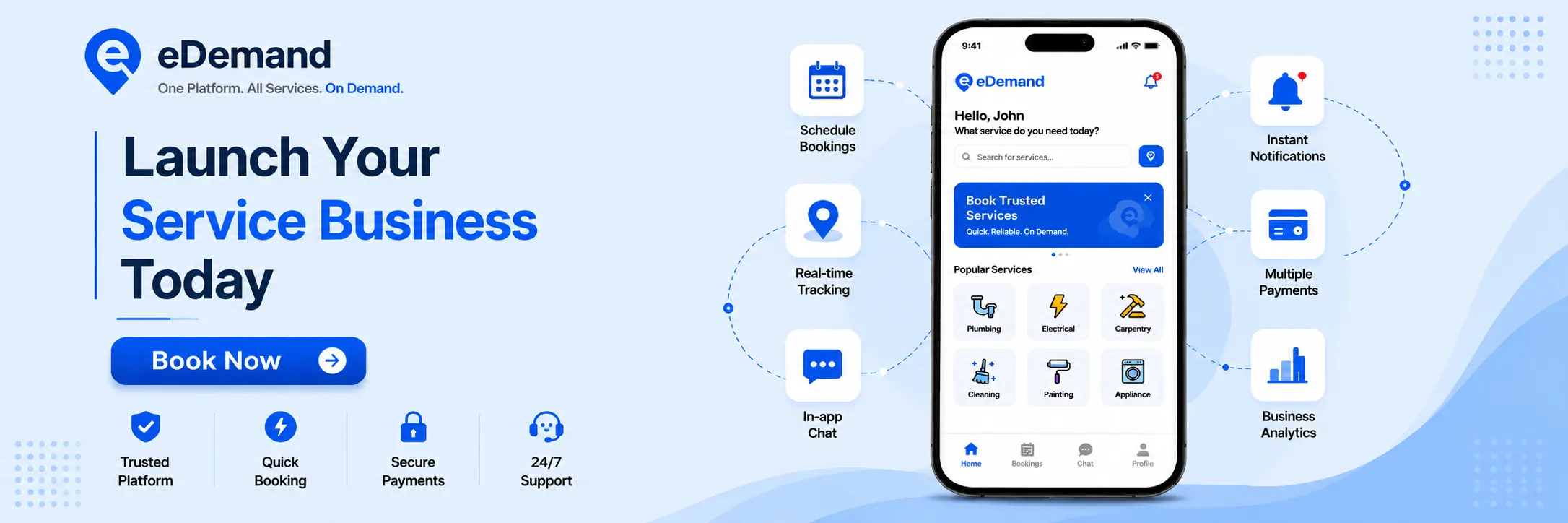
So you want to launch a handyman booking business, but you don't want to spend eight months and a small fortune building an app from the ground up. Fair enough, that's the exact problem eDemand was built to solve.
Here's the thing about the on-demand service space: customers expect to book a plumber or an electrician the same way they order food, a few taps, a confirmed slot, done. If your platform can't deliver that, they'll bounce to whoever can.
That's where a ready-made on-demand booking service system like eDemand comes in. Instead of writing code from scratch, you get a working foundation customer app, provider app, website, and admin panel and spend your time on the part that actually matters: growing the business.
This guide walks through what eDemand includes, what makes it different from a dozen other scripts on the market, what it costs, and who it's actually built for. By the end, you'll know whether it's the right fit for your handyman platform, no guesswork required.
What Is eDemand?
eDemand is a multi-vendor, on-demand handyman platform built on Flutter, Next.js, CodeIgniter, Dart, and Firebase. In plain terms: it's a full package of apps and a website that lets customers book home services, plumbing, electrical work, cleaning, appliance repair, you name it, while providers manage their own bookings from a separate app.
What sets it apart from a lot of demo-only products is that it's not theoretical. The customer app and the provider app are both live on Google Play and available through TestFlight for iOS testing right now. That's not a small detail. A lot of app scripts look great in a sales video and fall apart the moment you try to actually run them. eDemand's apps are already functioning in the real world, which says something about how solid the underlying on-demand service app script actually is.
Core Features Worth Highlighting
A handyman platform lives or dies on the small details customers actually use every day. Here's what eDemand handles well:
-
Nearby provider discovery: Customers see local professionals with ratings and visiting charges upfront, no surprises
-
Categories and subcategories: Plumbing, carpentry, cleaning, appliance repair, sorted logically instead of dumped into one messy list
-
Detailed service pages: Photos, reviews, FAQs, and pricing, so customers know what they're booking before they commit
-
Time-slot scheduling: Pick a date and an actual available window, not a vague "someone will call you"
-
Saved addresses: Enter a location once and reuse it for every future booking
-
In-app chat: Customers and providers can sort out details without leaving the app
-
Promo codes: Both platform-wide discounts and provider-specific offers
-
Notifications: Booking confirmations, status updates, and reminders that keep no-shows to a minimum
None of this is groundbreaking on its own, but that's kind of the point. What matters is that it's all already built and tested, so your handyman services websites and apps can go live in weeks, not sit on your to-do list for the next six months.
Why Choose eDemand Over Other Options?
Plenty of scripts exist, but most look identical once you dig past the marketing page. Here's what actually separates eDemand from a generic on-demand service app template once real users start booking.
1. SEO-ready architecture
The website ships already structured for search engines to crawl and index cleanly. That means you can start ranking for local handyman searches right after launch, instead of paying a developer to rebuild the site's foundation later.
2. Multi-language and RTL support
Right-to-left languages and multiple language options are built in from day one, not patched on afterward. That matters if you're targeting markets like the Middle East or South Asia, where a single-language app quietly limits your reach.
3. A dual revenue model
You're not locked into one income stream. Commissions on completed bookings and provider subscription packages run side by side, so a slow month on one side doesn't necessarily mean a slow month for the whole business.
4. Custom job requests and bidding
Not every job fits a fixed listing. Customers can post a description of what they need, and providers bid on it, handy for odd jobs, larger projects, or anything that doesn't fit neatly into a standard price tag.
5. Built-in AdMob and AdSense support
Once your platform starts pulling in real traffic, monetization doesn't stop at bookings. AdMob and AdSense are already integrated, giving you a second revenue channel from ad impressions without any extra development work.
How to Launch Your eDemand Platform?
Getting from purchase to a live on-demand booking service doesn't take a development team. Here's roughly how it goes:
-
Purchase eDemand through the Envato marketplace using your preferred payment method
-
Download the source code and go through WRTeam's documentation for setup; it's written step by step, not assuming prior technical depth
-
Configure your branding logo, colours, app name, and business categories so it looks and feels like your business, not a generic template
-
Test the customer and provider flows before going live, from booking a service through to payment and completion
-
Publish your apps to the Play Store and App Store, and launch your website.
If coding isn't your thing, WRTeam also offers paid installation and customization services, so this whole process doesn't have to fall on your shoulders.
Payment Gateway Support
Nobody wants to lose a customer at checkout because their preferred payment method isn't available. eDemand ships with a wide spread already integrated: Stripe, Razorpay, PayPal, Paystack, Flutterwave, Xendit, Cashfree, and a pay-on-service option for customers who'd rather settle up after the job's done.
That range matters more than people expect. A platform launching in Nigeria needs Paystack or Flutterwave. A platform launching in India leans on Razorpay or Cashfree. Covering multiple regions out of the box saves you from a painful mid-launch scramble to add a missing gateway.
Licensing Breakdown
|
Feature |
Regular License ($69) |
Extended License ($350) |
|
Domain usage |
1 domain |
1 domain |
|
Support |
6 months |
1-year priority support |
|
Use case |
Personal projects |
Personal projects, Commercial projects (paid use or resale) |
|
Updates |
Lifetime free |
Lifetime free |
|
Admin panel installation |
Not included |
Included (cPanel, one-time) |
|
Dedicated WhatsApp support |
No |
Yes |
|
FREE Website Setup |
No |
Yes (One Time If Applicable) |
|
AnyDesk Support |
No |
Yes |
The Regular license is ideal for someone testing the waters with a personal project. The Extended license is the one to pick if you're planning to charge customers, sell subscriptions, or resell the platform to clients, which covers most people actually launching a business here.
Either way, it's a one-time purchase for the full on-demand delivery app source code, not a rental. Compare that to typical SaaS subscription platforms charging monthly fees indefinitely, and the math starts favouring ownership pretty quickly once you're past year one.
For a closer look at what each license includes, check out our blog post on packages. Regular License OR Extended License
What's Included in the Package
When you buy eDemand, you're not just getting one app; you're getting the whole operational stack:
-
Customer App: (Android and iOS) where users search, compare, and book services
-
Provider App: Where service professionals manage their listings, availability, and jobs
-
Website: A responsive front end that builds credibility and pulls in organic traffic
-
Admin Panel: The control room for managing users, providers, categories, and payouts
-
Provider Panel: A web-based dashboard for providers who prefer managing bookings from a desktop
That's five connected pieces working as one system, not five separate purchases bolted together after the fact.
Who Should Use This
Solo entrepreneurs looking to launch a local handyman marketplace without hiring a development team. You get customer acquisition tools, payment processing, and provider management without touching a line of code beyond basic configuration.
Agencies and developers building client projects on a proven foundation instead of starting from zero every time. Given how many of the reviews come from resellers, this is clearly already happening in practice; it's not a theoretical use case.
Expert Tips Before You Launch
-
Test every payment gateway with a real (small) transaction before opening bookings to the public
-
Set clear provider onboarding rules early. Vague verification standards lead to trust issues down the line
-
Use the multi-language support from day one if you're targeting more than one region, rather than retrofitting it later
-
Keep your service categories tight at launch. Five well-organized categories beat twenty half-empty ones
Key Takeaways
-
eDemand is a working, tested on-demand delivery app source code package, not just a template sitting untested
-
It includes five connected pieces: customer app, provider app, website, admin panel, and provider panel
-
A dual revenue model (commissions plus subscriptions) gives you more than one way to earn
-
Eight payment gateways are already integrated, covering most global markets
-
Licensing is one-time, not subscription-based, with lifetime free updates
-
Real buyer feedback consistently praises support quality alongside code quality
-
It suits both solo entrepreneurs and agencies building for clients
Conclusion
Launching a handyman platform doesn't have to mean choosing between a rushed, half-working app and a year-long build. eDemand sits right in the middle of a tested, already-functioning on-demand service app template with the apps, website, admin tools, and payment integrations already in place. You're not starting from a blank screen; you're starting from something that's already live on app stores and already working for real users.
Whether you're a solo entrepreneur testing a local market or an agency putting together client projects, eDemand gives you a foundation that's proven itself in production, not just in a sales demo. WRTeam built it to get you from purchase to launch without months of guesswork in between. If you've been sitting on a handyman business idea, this is about as close to "just add branding" as it gets.