
The property market has experienced a colossal digital transformation, and mobile applications have become the major device used in the search of the property. Whether you want to purchase your dream house or simply rent an apartment, being able to have the right features of the apps can be the difference in your search for a house.
Why Real Estate Apps Matter in 2026
Days of turning on the classifieds in the newspapers or going round neighborhoods and finding For Sale signs are long gone. The state of the art real estate management software has transformed the way we find, review and acquire property. As more than 90 % of people begin their home shopping online, a feature-rich real estate app allows conducting it readily, which is even necessary.
We shall discuss the top 10 features that every real estate application must have in 2026.
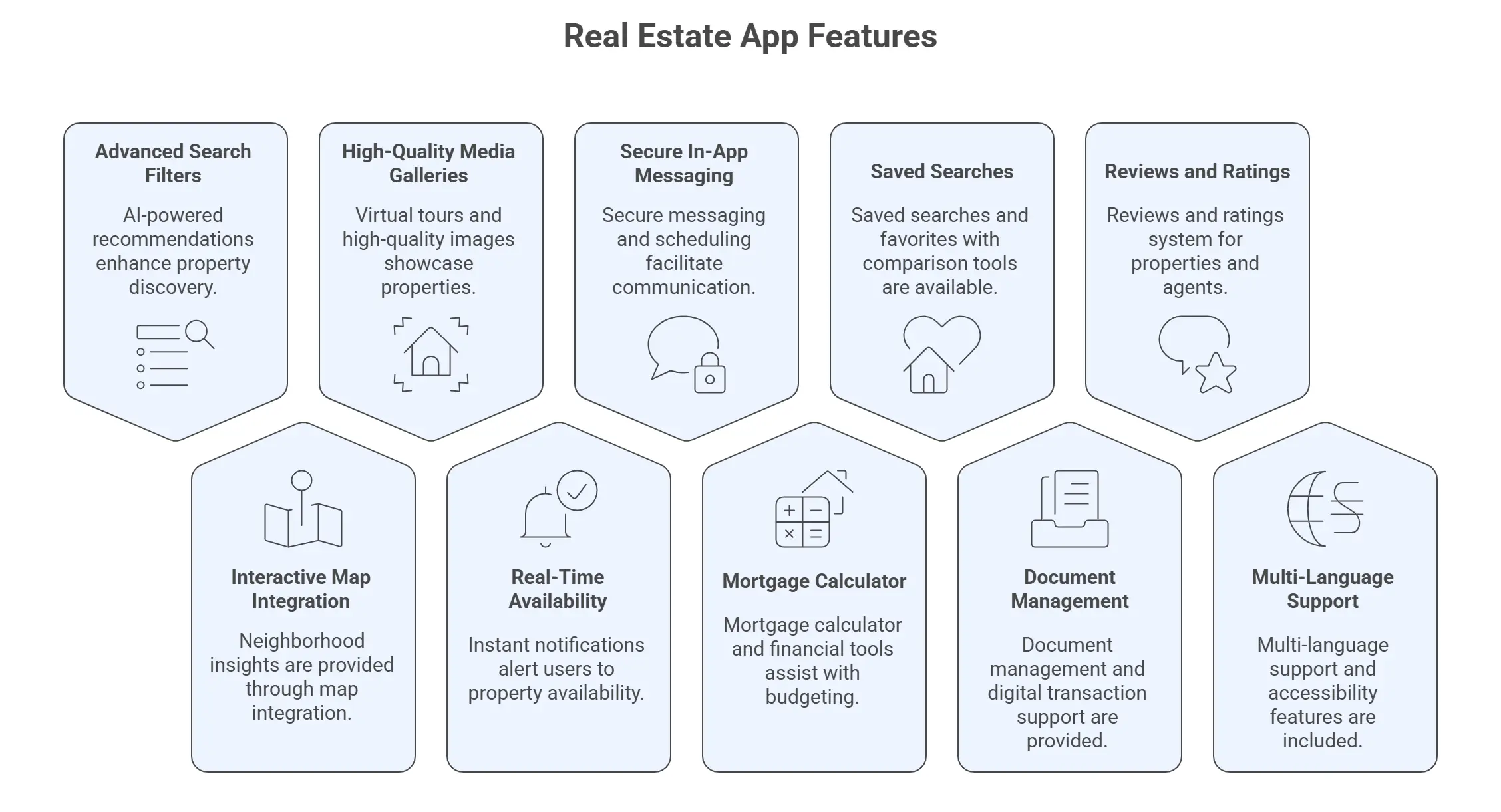
1. Advanced Search Filters with AI-Powered Recommendations
A great real estate application has its search functionality as its basis. The users should be able to sort the properties according to various criteria such as location, price range, type of property, number of bedrooms, facilities among others.
The modern apps extend beyond simple filters and include the AI algorithms, which learn based on user behavior and preferences. These smart systems help in saving you infinite time by learning your search habits and viewing history and, thus, suggesting properties that suit your special needs.
2. Interactive Map Integration with Neighborhood Insights
Everything about real estate is location. The powerful property listing website template must have interactive maps that enable people to see the location of the properties and get to know the neighbourhood virtually.
Key map features include:
-
Satellite and street view capabilities
-
School, hospital, shopping center and public transport proximity markers
-
Crime statistics and security scores
-
Walkability scores
-
Commuting time and highway traffic patterns
This holistic approach assists buyers and renters to make a better decision not only about the house that they will stay in, but about the whole society that they will become a part of.
3. High-Quality Media Galleries with Virtual Tours
The property listings are determined by visual content. The Apps have to encourage high-resolution photo gallery, virtual tours in 360 degrees, video walkthroughs which allow the users to have a preview of the properties without walking out of their homes.
A real estate app source code should have the which is optimized to support big media files without slowing down the load time. The image zoom feature, floor plan view, and virtual staging technology contribute immensely to the online window shopping.
4. Real-Time Property Availability and Instant Notifications
There is no worse feeling to the users than getting in love with a property and finding that it is no longer there. Immediate updates are going to make listings accurate to those who are available.
Push notification systems are notified whenever:
-
Newest properties that meet their requirements come in
-
On saved listings, price changes take place
-
Open house times are put out
-
Their propositions are responded to
This urgency keeps the user at the edge and never lets him/her miss any possible opportunities.
5. Secure In-App Messaging and Scheduling
Real estate deals heavily rely on communication. An effective sample of a real estate mobile app template will also give a secure messaging service that will connect renters, buyers, sellers, agents, and landlords inside the application.
The important communication characteristics are:
-
Personal communication with real estate owners and agents
-
Property viewer scheduling tools
-
Share documents ability
-
Integration of call and video conferencing
-
History of messages and thread of conversation
This centralized communication prevents the use of various apps and places all the chats of a property enterprise in a single location.
6. Mortgage Calculator and Financial Tools
Affordability is an essential concept to buyers. Financial calculators are incorporated in these to enable the user to know what is actually within their reach before they begin to think seriously about owning properties.
Such tools ought to compute:
-
Interest and down payment sources of mortgage per month
-
Estimates of property taxes and insurance
-
The cost of ownership considering a lifetime
-
Rent vs. buy comparisons
-
Rental property investment projections of returns
Apps give users clear financial information, thus helping them make sure they can afford to make sure decisions within their budget.
7. Saved Searches and Favorites with Comparison Tools
The process of property search can last weeks or months. Users should be able to store interesting listings and make collections so that they can refer to it easily.
An advanced real estate website script will allow someone to:
-
Saved unlimited property listings
-
Make bespoke folders and tags
-
Create back-up searches that are automatically updated
-
Compare various properties at a time
-
Favorite share with their family members or roommates
-
Make personal notes to listings
These organizational elements assist users in following their options in a more systematic way and make more reasoned comparisons.
8. Document Management and Digital Transaction Support
The trend in modern real estate applications is no longer browsing of property but enabling the whole process to occur on the computer. Document management capability enables users to upload, store and share needed paperwork safely.
Advanced platforms support:
-
Capabilities of digital signatures
-
Cloud based document storage
-
Rental tracker application
-
Tools offer submission and negotiation
-
Lease agreement management
With the digitization of these processes, apps eliminate the paperwork inconveniences and accelerate the process to everybody.
9. Reviews and Ratings System for Properties and Agents
In judgments of real estate, trust is the most important aspect. A transparent review system would enable former tenants, buyers, and clients to leave their impressions about certain properties, landlords, property management companies, and real estate agents.
This social feature assists the user:
-
Do not use problematic properties or agents who are not professionals
-
Find out high-rated specialists and buildings in good condition
-
Use superior decisions made on experience
-
The contribution to a reliable market place ecosystem
Authentic reviews will provide credibility and contribute to trust in this platform.
10. Multi-Language Support and Accessibility Features
The real estate markets are becoming more global and the apps should serve a wide range of users. The use of multi-language features will make sure that no non-native speakers find it hard to navigate the platform.
It should have accessibility features that entail:
-
Voice over and voice search
-
Variable font sizes and high contrast features
-
Screen reader compatibility
-
Easy, user-friendly navigation of all ages
-
International users currency conversion
These universal features increase the scope of the app and make everybody able to buy and sell properties successfully irrespective of their background and capabilities.
The Technology Behind Comprehensive Real Estate Solutions
To create an app that possesses all these features, it would need a well designed frontend and a well organized infrastructural back end. The solutions such as eBroker by WRTeam offer end-to-end real estate management software that includes all these critical features in an off-the-shelf solution.
The benefits of such platforms include tested real estate app source code which has been performance, security and scalability optimized. No matter whether you are a real estate agency, property management company or an entrepreneur who wants to venture into the PropTech arena, having a solid foundation will bring you to time-to-market faster.
Future-Proofing Your Real Estate App
The further into the future we get to 2026, the more new technology is changing the expectations of the users. To an augmented reality property previews, blockchain-based security of transactions and predictive analytics are becoming normal and not innovative.
The trick of success here is to select a property listing website template or mobile application that is designed with the thought of extensibility in it one that can be extended with new functionality as technology advances without imposing the full burden of re-development.
Conclusion
The app market in the future real estate is characterized as full-fledged and capable of catering to the needs of the users in all their property journeying processes starting with their beginning search and ending with the final exchange. Whether you have the needs to buy and sell houses or rentals, these ten features are the bare minimum to expect in the platform to compete.
On the part of buyers and renters, the demand of the apps with these features would guarantee to them a smooth and more knowledgeable experience during the search of the property. As a business and a developer, you are set to succeed in a rather competitive marketplace by implementing such features on your platform.
Real estate is going to be digital, mobile and user-centric. With these crucial functions at the forefront of your priorities, you will be in the position to cater to the needs of the contemporary property hunters as well as be relevant in the crowded PropTech landscape. These features are not negotiable in the quest to be successful in the year 2026 and beyond regardless of whether you are starting anew or building on the existing real estate mobile app template solutions.