
Introduction
Entrepreneurs building a hyperlocal delivery business have always faced the same frustrating choice: run one system for instant, on-demand orders and a completely separate system for a full-scale online store. Two codebases, two databases, and double the maintenance for what should be a single business.
WRTeam has closed that gap. SnapBuy, the newest addition to the WRTeam Marketplace, is now live, and it treats quick delivery and traditional online retail as two sides of the same platform rather than two competing products. After months of development and testing, WRTeam has built a system where every store, product, and order carries a channel tag from the start, either Quick Commerce or eCommerce, so a business can run a 15-minute grocery delivery service, a nationwide retail brand, or both together, without maintaining duplicate infrastructure.
What Is SnapBuy?
SnapBuy is a complete quick commerce and eCommerce platform built to help businesses launch, manage, and grow a modern shopping and delivery operation from one connected system. Rather than running separate apps for instant local delivery and scheduled online retail, SnapBuy folds both into a single backend, where every product, delivery zone, cart, and order already knows which channel it belongs to.
The platform is made up of four connected applications, all powered by one Laravel backend that stays the single source of truth for pricing, permissions, and live data:
-
Admin Panel , the control center for products, stores, zones, and permissions
-
Customer Web App , a fast, mobile-friendly storefront
-
Customer Mobile App (iOS and Android), kept in sync with the web app in real time
-
Delivery Boy App ( iOS and Android), built for riders to accept orders and confirm handovers
Because all four apps read from the same backend, a price change or a new banner made once in the admin panel shows up instantly across web, Android, and iOS. Nothing needs a separate rebuild or resubmission.
On the technology side, SnapBuy runs on Laravel for the backend, Next.js for the web storefront, Flutter for both mobile apps, MySQL as the database layer, Firebase for notifications and live tracking, and Node.js to build and run the storefront. Every checkout is priced on the server, every payout is logged, and every admin action is permission-gated, the kind of operational discipline usually reserved for far more expensive enterprise systems.
Two Business Models Running as One Platform
What separates SnapBuy from a typical eCommerce template is how it treats the two ways people shop today.
Quick Commerce
Covers the "I need this in minutes" orders, groceries, pharmacy items, or anything a customer wants delivered fast. Customers get live map tracking of their rider from pickup to doorstep, along with a direct call button and a support chat shortcut, turning the usual "where is my order" anxiety into something visible and predictable. Because in-house riders confirm handovers with an in-app OTP, both the customer and the business are protected from delivery disputes.
eCommerce
Covers the "I can wait a few days" purchases, a full product catalog, planned orders, and everything that looks like a traditional online store. Customers shopping this way can cancel a single item without disturbing the rest of their order, something Quick Commerce orders do not need since they move in full or not at all.
A single toggle at the top of the app lets a customer switch between the two without opening a separate app. On the backend, the admin dashboard shows how each model is performing side by side, so a business owner can see at a glance whether instant delivery or scheduled shopping is driving more revenue in a given month. This is the core idea behind SnapBuy: two very different shopping behaviors, powered by one connected ecosystem.
One Platform. Two Business Models.
Run Quick Commerce and eCommerce from a single platform with unified products, orders, stores, customers, and deliveries.
What Makes SnapBuy Different
There is no shortage of ecommerce applications in the market. Here is what actually sets SnapBuy apart.
Two business models, one platform
Quick Commerce and eCommerce are not bolted together, the channel is a core part of every product, store, zone, cart, and order.
Four complete apps in one purchase
Admin panel, customer web, customer app, and delivery app, all included and all connected to the same backend.
Real delivery operations, not a demo
OTP-verified handovers, COD cash reconciliation, commission-based rider bonuses, and an approval-based withdrawal flow modeled on how courier operations actually run.
Server-authoritative pricing
Every price, tax, and delivery charge is recalculated server-side, closing off pricing exploits before they happen.
True multi-country architecture
Currency, timezone, payment gateways, and policies are configured per country, with historical orders staying accurate even after settings change later.
Visual, no-code storefront control
A draft-and-publish home builder and full translation management mean most changes never touch a line of code.
A modern, hireable tech stack
Laravel, Next.js, and Flutter are frameworks any developer team can pick up quickly.
See It In Action
Reading about a platform only goes so far. WRTeam has made live demos available for all four applications:
Each demo runs on real, working data, so it is possible to click through the actual homepage builder, the live order tracking screen, or the rider's delivery workflow before making any decision.
10 Payment Options, Ready From Day One
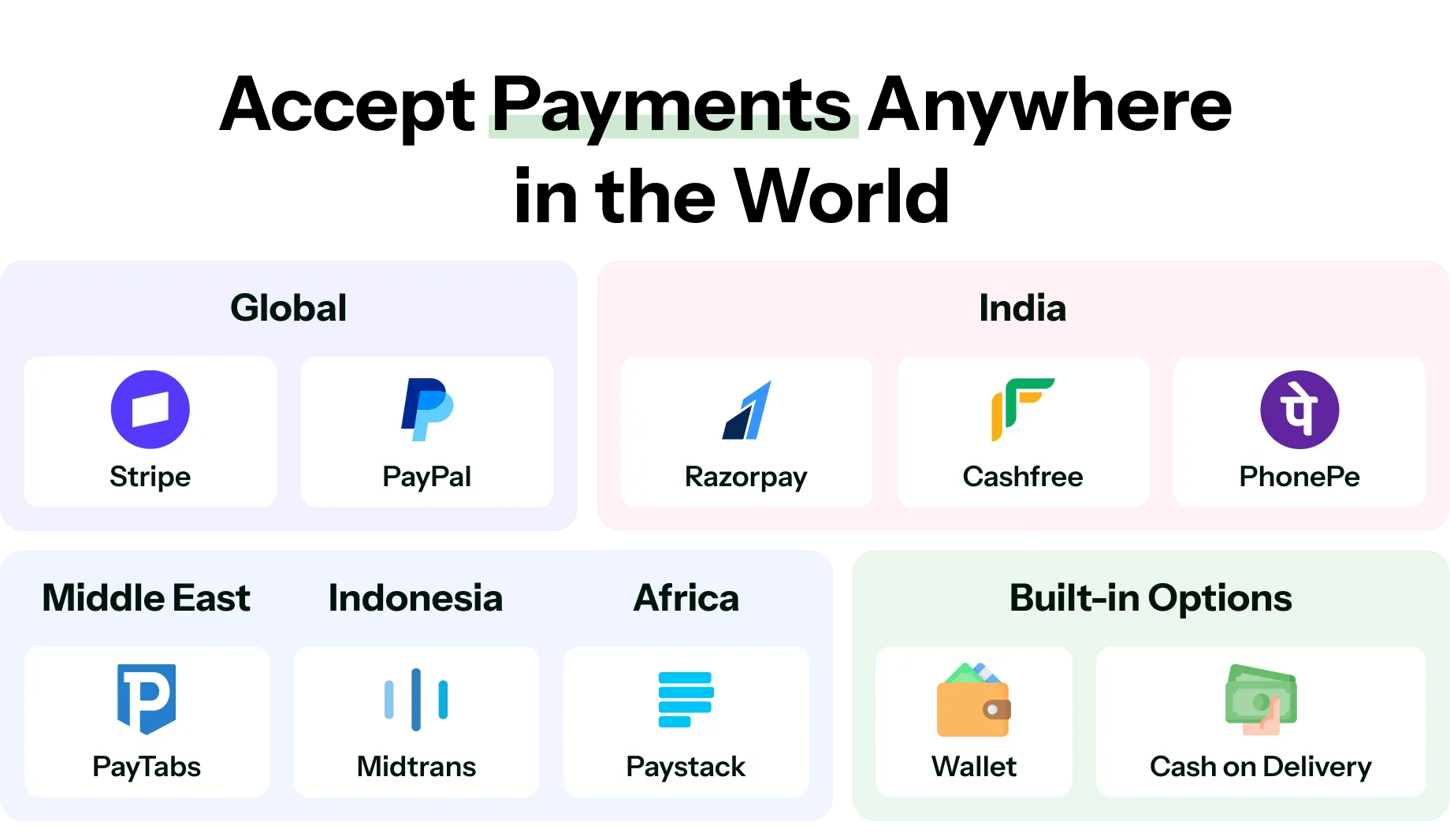
A sale falling through at checkout because of a missing payment option is a preventable loss, so SnapBuy ships with ten payment methods chosen around where they matter most.
Stripe and PayPal cover global, internationally trusted checkout. Razorpay, Cashfree, and PhonePe handle cards, UPI, netbanking, and wallets for the Indian market, where UPI already drives most everyday payments. Paystack supports card and mobile money for African consumers, Midtrans connects to the payment methods Indonesian shoppers already use, and PayTabs processes cards and wallets across the Middle East and North Africa.
Alongside these, an in-app wallet and Cash on Delivery are available everywhere by default, with automatic cash reconciliation for riders handling COD orders. Every gateway can be switched on or off per country and per store, so a business only shows the payment methods that actually make sense in that market, and every price a customer sees is verified again on the server before the order goes through.
A Few Standout Features
SnapBuy ships with more than 38 features across shopping, delivery, and admin operations, but a handful are worth calling out on their own.
AI-powered product descriptions & SEO metadata
Instead of manually writing a description and SEO tags for every single product, the built-in AI generates them automatically. This saves hours of content work and helps products get found more easily in search.
Visual, map-based delivery zone drawing
Admins draw delivery coverage areas directly on a map instead of entering coordinates manually, and the system automatically prevents zones from overlapping. This keeps delivery coverage clean and avoids two stores accidentally competing for the same street.
Flexible delivery pricing
Delivery charges can be set as a flat fee, a slab based on distance, a per-city rate, a per-area rate, or dynamic surge pricing during busy periods. This lets a business match its delivery pricing strategy to its actual operating costs.
Refer-and-earn program
Every customer gets a shareable referral code they can send to friends. When someone signs up using it, both sides are rewarded, turning happy customers into a free, word-of-mouth growth channel for the business.
Multi-language and RTL layout support
The entire app can switch languages instantly, including full right-to-left layouts for languages like Arabic and Urdu, plus a choice of light or dark theme. This makes the same platform genuinely usable for customers in different regions and cultures, not just translated.
Structured returns & refund workflow
Returns move through a clear, staged process, and once approved, refunds are automatically credited to the customer's wallet and the returned stock is added back to inventory. This keeps after-sales operations predictable instead of handled case by case.
Who Is SnapBuy For?
SnapBuy is built for a wide range of businesses and teams:
-
Entrepreneurs launching a grocery, pharmacy, food, or hyperlocal delivery business
-
Businesses building a full-catalog online store or ecommerce marketplace
-
Agencies that want to offer a ready ecommerce flutter app and web solution to multiple clients
-
Developers who want a clean, modern, well-documented codebase they can extend and resell
Whether the plan is to launch in a single city or expand across countries and languages, SnapBuy is designed to scale with the business rather than get rebuilt around it.
What You Get With SnapBuy
-
Full source code for the admin panel, Next.js storefront, and both Flutter apps, completely unlocked
-
Step-by-step setup documentation for backend, web, and mobile
-
Demo data and assets for an instantly working demo after installation
-
Regular updates delivered through the built-in, purchase-code-gated updater
-
Clean, commented code structured for extension
-
Dedicated technical support for installation questions and reported bugs
This Is Just the Beginning
SnapBuy represents months of focused work from WRTeam's development, design, and product teams, shaped around real feedback from businesses that actually run commerce and delivery operations day to day. It joins the WRTeam Marketplace as a complete, ready-to-launch platform for anyone building the next hyperlocal or full-catalog commerce brand, and for WRTeam, it marks the start of what the platform can grow into next.
Explore SnapBuy, check the live demos, and see the full feature set on the WRTeam Marketplace.