
The truth is, many people who want to start an online grocery delivery business never begin, not because the idea is bad, but because the process feels too overwhelming.
Where do you even begin? Do you need a custom app? A website? Multiple delivery partners? Vendor onboarding? Payment gateways? The list increases rapidly, and soon, the dream lies motionless in a notes application covered with cyber dust.
However, here is the thing that those people are lacking: you do not have to construct everything in 2026. The tools exist. The market is ready. And the barrier to entry is as low as it has ever been, particularly with solutions like a flutter multi-vendor grocery app, which makes the whole process simple when you know what you are doing.
This blog provides a step-by-step guide to starting your online grocery delivery business, with practical insights based on what’s truly working today.
Why 2026 Is the Moment for eGrocer
The behaviour of the consumer has changed permanently. People now expect groceries to arrive at their doorstep quickly, with real-time tracking and reliable service, just like booking a ride. What was once a niche market has now become a standard expectation for everyday consumers.
The most interesting feature of 2026 is the emergence of hyperlocal commerce. Customers prefer buying groceries from nearby local stores rather than far-off warehouses. This provides the entrepreneurs with an enormous opportunity to connect local sellers with digital-first clients without having to own a single warehouse, particularly by starting with a multi-vendor grocery delivery script.
Now this is the perfect time to get started. It is time to get started and take you through the steps of building your own online grocery business.
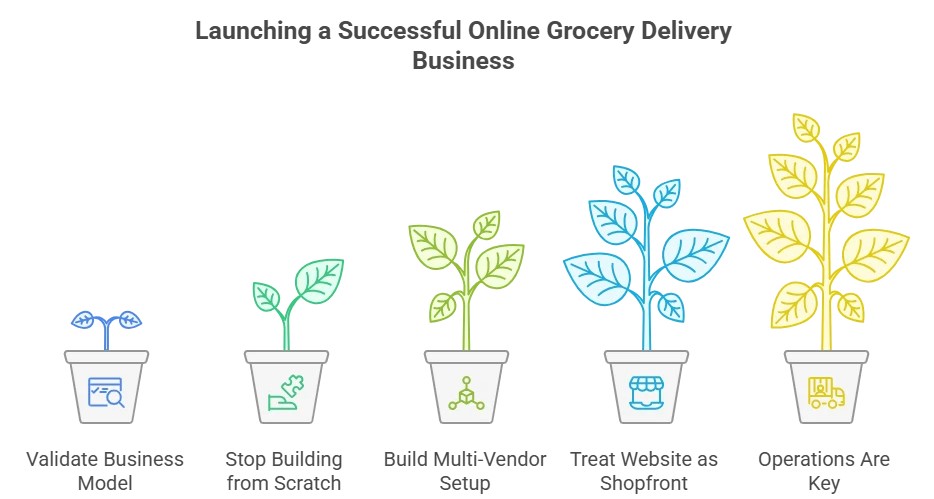
Step 1: Validate Your Business Model First
Before embarking on the construction of anything or coming up with a logo, you must first clarify which kind of grocery business you intend to operate.
Three models worth considering:
-
Hyperlocal Delivery: Partner with local stores, deliver within a local neighbourhood, have fast service and avoid inventory headaches
-
Multi-Vendor Marketplace: You have a number of sellers on your site. You earn commissions. This scales beautifully
-
Dark Store Model: You store your inventory in small fulfilment centres of your own. Increased control, increased investment
For most first-time founders in 2026, the multi-vendor marketplace model is a smart way to start since you don’t need to manage or hold inventory. Sellers bring the products. You take the platform and take the commissions.
Step 2: Stop Planning to Build from Scratch
This is where many entrepreneurs end up spending months or a lot of money. Building a grocery delivery app for Android and iOS with an admin panel, vendor dashboard, live tracking, and payment systems is a major technical task. A smarter approach is to use a ready-made multi-vendor grocery delivery script.
A well-built script gives you:
-
A completed flutter mobile application (Android and iOS are built with a single set of code)
-
A vendor management system whereby sellers handle their inventories
-
A driver delivery partner app
-
A user interface that you can manage
-
A web version that would allow the customers to shop too, using their browsers
This is not cutting corners. This is a smart allocation of resources. You can launch faster, test your market early, and focus your energy on growing the business instead of fixing technical issues.
Step 3: Build a Multi-Vendor Setup That Scales
The real advantage of a flutter multi-vendor grocery app is how it simplifies building a marketplace where buyers and sellers connect easily. Vendors can sign up, list their products, and manage orders on their own, without constant supervision.
What a good multi-vendor setup looks like:
-
Sellers create accounts and receive their respective dashboards
-
Sellers are approved or rejected by role-based controls through the approval of the admin
-
Nested category support is used in the categorisation of products
-
Every seller has their orders, stocks, and profits
-
All this is monitored via the central administration panel
Such a structure indicates that you can have a platform serving one grocery store today and hundreds of vendors tomorrow without rebuilding.
Step 4: Your Website Is Your Shopfront: Treat It That Way
A mobile app alone isn’t enough. Many customers prefer to browse and place their first orders through a browser. That’s where a grocery store website template becomes essential for your business.
Your website should be:
-
SEO-friendly so that customers can find you on Google when they type in "grocery delivery near me"
-
It’s designed to work smoothly across desktops, mobile browsers, and tablets
-
It also loads quickly, which is important because users won’t wait around for a slow homepage
-
Localised to show the listings of products and areas of delivery to where your purchasers physically reside
The benefit of a good template is that it’s ready to use right away, already designed and optimised, and only needs a few weeks of customisation to match your brand.
Step 5: Operations Are Where the Business Lives
The application and the webpage are but a point of entry. The actual business operates on business.
Key operational pillars to set up:
-
Live Order Tracking: Customers expect to track their deliveries in real time; it’s essential in 2026
-
POS Integration: If your vendors have physical stores, their offline sales should sync seamlessly with the online system
-
Several payment gateways: UPI, credit cards, cash on delivery, and offering wallets to minimise checkout drop-off
-
Delivery partner: Easily assign, monitor and pay delivery agents through one panel
-
Promo codes and memberships: They are your customer retention tools. Use them early and often
Why WRTeam's eGrocer Is Built for This
eGrocer is a solution developed by WRTeam that helps entrepreneurs launch a multi-vendor grocery marketplace without building everything from scratch.
Here is what makes it stand out:
-
Flutter allows you to manage both platforms with a single codebase, helping you reduce development effort and cost
-
Laravel admin panel to have a solid, safe, or secure backend
-
Next.js web version, search engine optimised, fast, and responsive automatically
-
In-store sales are tracked through a built-in POS, allowing vendors to sync offline transactions with the online system
-
Geolocation-Based Listings: Customers can view products available within their delivery area
-
One of the actually helpful UX features is voice- and location-based product search
-
Membership plans: add subscription levels for loyal customers immediately at the admin panel
-
Support multiple languages for a global audience
-
Admin, seller and delivery partner role access
-
Live order tracking on the application and the web platform
The multi-vendor grocery delivery script handles the complex operations, so you can focus on growing your vendor network and customer base.
It is not merely a template for applications. It is an entire business infrastructure.
Conclusion
The grocery delivery market moves fast and rewards quick improvements. You don’t need a perfect product on day one, just something that works, which you can refine over time based on real customer feedback.
The right flutter-based multi-vendor grocery solution, a professional grocery store website template and a reliable multi-vendor delivery system will enable you to have all that you need to launch, grow, and scale an actual business in 2026.
WRTeam’s eGrocer solution brings everything together on one platform, ready to launch. Your competitors are already in motion. Whether you are or not is the question.