When a deployment goes wrong, the instinct is to find someone to blame. A developer pushed bad code. An engineer skipped a step. Someone didn't follow the checklist.
But here's what most post-mortems eventually reveal: the people were working exactly as the system allowed them to.
The real problem wasn't the developer. It was the process that put them in a position to fail.
Deployment failures are one of the most expensive, disruptive events in modern software delivery. Yet most organizations keep fixing the wrong thing cycling through blame, retraining, and stricter policies while the underlying workflow stays broken.
This article breaks down why deployment failures are almost always a systems problem, what those problems actually look like, and how engineering teams can build processes that make reliable releases the default, not the exception.
What Actually Causes Most Deployment Failures
According to the Google SRE Book, the majority of production incidents are caused by changes to the system deployments, configuration updates, and infrastructure changes. The pattern holds across industries and team sizes.
Here are the most common root causes:
Manual Deployment Steps
When deployments rely on humans executing a series of steps especially under time pressure errors are inevitable. Any process that requires someone to "remember" a step is a process waiting to fail.
Weak or Missing CI/CD Pipelines
Without automated build, test, and deployment pipelines, teams are essentially flying blind on every release. According to the GitLab 2023 Global DevSecOps Report, teams with mature CI/CD practices deploy significantly more frequently with far fewer failures.
Get the full breakdown in what a deployment pipeline is and why it keeps breaking.
Inconsistent Environments
"It worked in staging" is one of the most common phrases in engineering post-mortems. When development, staging, and production environments aren't consistent, code that passes local tests can fail unpredictably in production.
No Rollback Strategy
Many teams can deploy but can't undeploy safely. When something goes wrong, the lack of a tested rollback path turns a minor incident into a major outage.
See how mature teams approach this in rollback vs roll-forward: how to handle failures without panic.
Missing Automated Testing
Code deployed without sufficient automated test coverage is code deployed with unknown risk. Manual QA alone cannot scale with modern release cadences.
Lack of Observability
If you can't see what your system is doing, you can't catch failures early. Without proper logging, metrics, and alerting, teams are reactive instead of proactive. Google's SRE documentation defines observability as a core reliability discipline for exactly this reason.
Poor Release Management
Large, infrequent releases bundle together too many changes. When something breaks, isolating the cause becomes extremely difficult. This is sometimes called "big bang" deployment, and it's one of the highest-risk patterns in software delivery.
Weak Cross-Team Communication
Deployments often touch infrastructure, backend, frontend, and database layers simultaneously. When teams don't communicate release dependencies clearly, surprises happen in production.
Why Blaming Developers Doesn't Solve the Problem
Blame feels productive. It gives a clear cause and a clear target. But in most cases, it's operationally useless.
Consider a scenario: a developer pushes a change that takes down production. Investigation shows they skipped a deployment checklist item.
The blame model says: they should have been more careful.
The systems model asks: Why does the checklist rely on memory? Why wasn't that step automated? Why did a single skip cause a full outage?
Human error is almost always a downstream symptom of a system that sets someone up to fail. This is a core principle of the blameless postmortem culture described in Google's SRE practices and it's adopted by high-performing engineering organizations worldwide.
When you blame the developer:
-
The broken process stays in place
-
Other developers will make the same mistake
-
Engineers become risk-averse and slow releases to protect themselves
-
The actual failure pattern repeats
When you fix the process:
-
The workflow becomes resilient to human error
-
The same failure mode cannot repeat
-
Teams build confidence to ship faster
People don't fail in a vacuum. They fail inside broken systems.
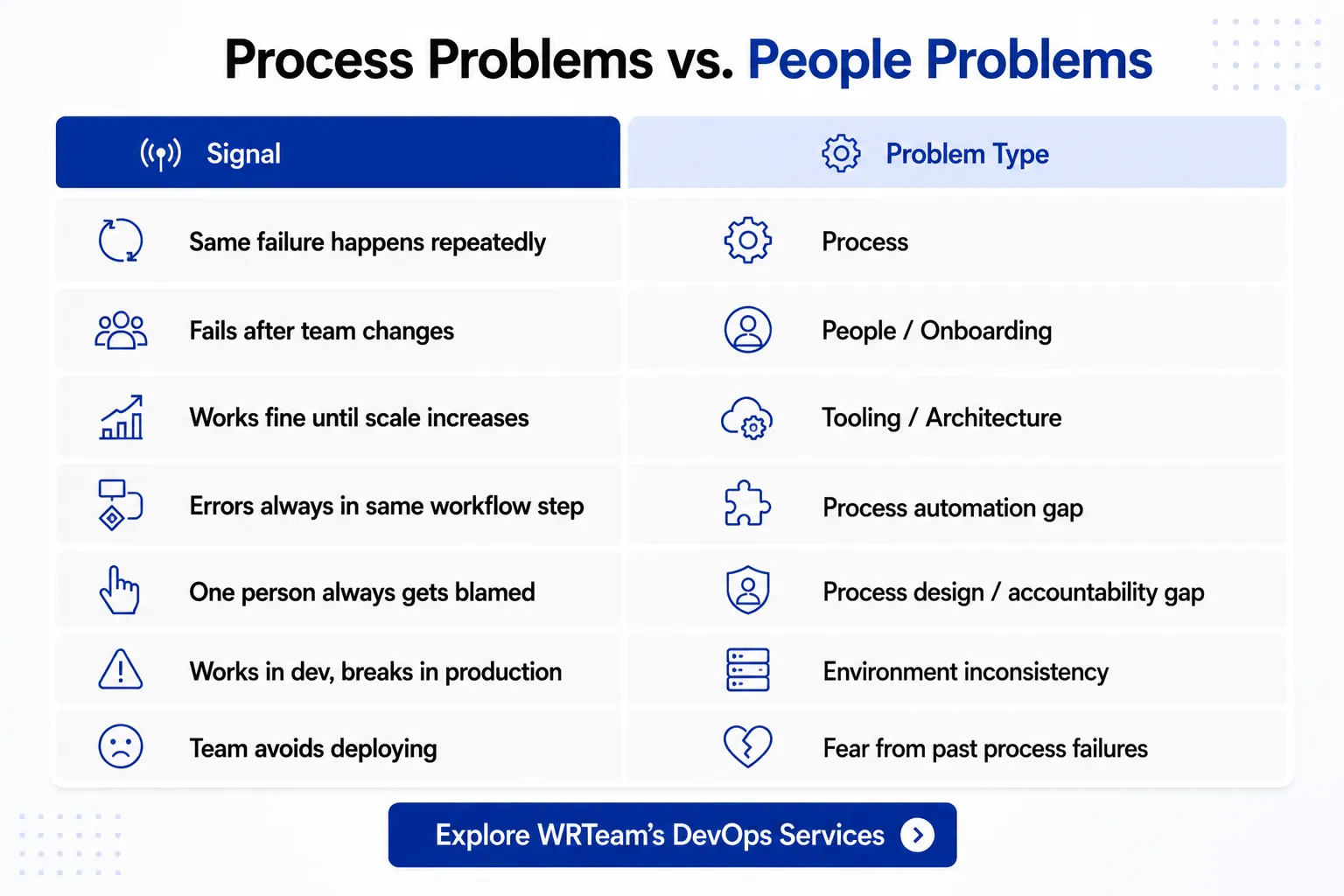
Process Problems vs. People Problems
Not every deployment issue is a process problem. Sometimes teams genuinely lack skills, documentation, or the right tooling. Here's how to tell the difference:
|
Symptom
|
Likely Root Cause
|
Fix
|
|
Same failure happens repeatedly
|
Broken process
|
Automate or redesign the workflow
|
|
Failure happens with every new hire
|
Documentation gap
|
Improve onboarding and runbooks
|
|
One team deploys fine, another doesn't
|
Skill gap or tooling inconsistency
|
Training or tooling standardization
|
|
Works in staging, breaks in production
|
Environment inconsistency
|
Standardize environments with IaC
|
|
Team avoids deploying on Fridays
|
Fear from past failures
|
Build safer, automated deployment pipelines
|
|
Hotfixes happen weekly
|
Weak QA and testing culture
|
Shift left on testing, improve CI coverage
|
|
Recovery takes hours after incidents
|
No rollback plan, weak observability
|
Build rollback automation and alerting
|
If the same types of failures are happening regardless of who is on the team, that's a process problem, not a people problem.
Common Deployment Workflow Issues
Here are the patterns that show up most frequently in organizations with high deployment failure rates:
No Staging Environment Deploying directly to production is one of the highest-risk practices in software delivery. Without a staging environment that mirrors production, there's no safe place to catch issues before they affect users.
Last-Minute Hotfixes Rushed changes pushed outside the normal release cycle skip most quality gates. A Stack Overflow Developer Survey finding consistently shows that unplanned deployment work is one of the biggest contributors to developer stress and system instability.
Manual Production Changes When engineers make infrastructure or configuration changes directly in production without version control those changes become invisible and irreversible. This is sometimes called "configuration drift."
Weak Testing Culture Teams that treat testing as optional or last-minute consistently ship more bugs to production. Shifting testing earlier in the development process significantly reduces defect escape rates.
No Rollback Strategy A deployment without a rollback plan is a one-way door. Every production deployment should have a tested, documented path back to the previous stable state.
Large Release Batches The bigger the release, the harder it is to isolate problems. Teams that ship in small, frequent increments have far lower blast radius when something goes wrong.
Lack of Monitoring Deployments without post-deployment monitoring are flying blind. Teams often don't know something has broken until users report it.
Poor Incident Response When something does go wrong, uncoordinated incident response multiplies downtime. Without clear roles, escalation paths, and communication protocols, teams scramble and recovery takes longer.
A structured deployment workflow supported by professional DevOps consulting services can significantly reduce exposure to all of these failure modes.
What Healthy Deployment Processes Look Like
High-performing engineering teams as consistently defined in the DORA State of DevOps research published on Google Cloud share a set of common practices that make reliable deployments repeatable, not accidental.
Automated CI/CD Pipelines
Every code change triggers automated build, test, and deployment processes. Humans define the rules; machines enforce them consistently. This removes the variability that causes manual deployment failures.
Incremental Deployments
Releasing small changes frequently rather than large batches infrequently reduces risk on every individual release. Techniques like canary releases, blue-green deployments, and feature flags allow teams to limit exposure during rollouts.
Infrastructure as Code (IaC)
Tools like Terraform, Pulumi, and AWS CloudFormation make infrastructure changes version-controlled, reviewable, and repeatable. The AWS blog and Microsoft Azure documentation both recommend IaC as a foundational reliability practice.
Automated Testing at Every Layer
Unit tests, integration tests, end-to-end tests, and performance tests should all run automatically before code reaches production. Testing is not a gate, it's a continuous quality signal.
Monitoring and Observability
Real-time dashboards, alerting on key metrics, structured logging, and distributed tracing give teams visibility into what their systems are doing before, during, and after a deployment. Cloudflare's engineering blog documents how observability practices directly reduce mean time to recovery (MTTR).
Clear Rollback Plans
Every deployment should have a documented, tested rollback procedure. Rollbacks should be practiced not theorized before they're needed in an emergency.
Version Control Discipline
All infrastructure changes, configuration changes, and application code belong in version control. No production changes should happen outside of a reviewable, auditable workflow.
Deployment Checklists and Runbooks
Automated checklists enforced by tooling and not memory reduce the risk of skipped steps. Runbooks document procedures so any qualified team member can execute a deployment safely.
Read how to build a deployment checklist your team will actually use.
Businesses investing in scalable cloud deployment services typically experience measurably more stable release cycles once these foundations are in place.
Why Process Maturity Improves Reliability
Process maturity is not just an engineering concern, it's a business continuity issue.
The DORA 2023 State of DevOps Report, published by Google Cloud, found that elite DevOps performers deploy multiple times per day with change failure rates below 5%, while low performers deploy monthly or less with failure rates above 15%.
The business impact of process maturity:
-
Predictable releases - Stakeholders can trust delivery timelines
-
Faster recovery times - When incidents occur, well-practiced teams recover in minutes, not hours
-
Reduced downtime - Every hour of downtime costs money; prevention is cheaper than recovery
-
Better developer productivity - Engineers spend less time firefighting and more time building
-
Improved customer experience - Stable deployments mean fewer user-facing disruptions
-
Lower operational stress - Teams that trust their deployment process ship with confidence instead of anxiety
Organizations that treat deployment process as an infrastructure investment not overhead consistently outperform those that don't.
Teams working with experienced infrastructure optimization services often discover that seemingly separate reliability problems trace back to a small number of shared workflow weaknesses.
Find out exactly what downtime is costing your business with the real cost of downtime calculates your hourly loss.
DevOps Culture and Operational Stability
Technology alone doesn't fix deployment failures. Culture is supported by the right technology.
Shared Responsibility
In high-performing teams, reliability isn't the exclusive domain of a DevOps or SRE team. Developers own the operability of what they build. Operations teams understand the systems they run. Everyone is accountable for deployment health.
Collaboration Between Teams
Many deployment failures happen at the boundaries between teams where handoffs are unclear and communication breaks down. Reducing those gaps requires intentional collaboration, shared tooling, and clear ownership.
Continuous Improvement
Teams that never review their deployment process never improve it. Regular retrospectives, metrics review, and process iteration are what separate teams that get better over time from teams that stay stuck.
Psychological Safety
The Google SRE workbook and academic research both confirm: teams that feel safe reporting problems catch failures earlier. Fear of blame leads teams to hide issues until they become outages.
Blameless Postmortems
After an incident, the goal is to understand what happened and why the system allowed it not to identify who to blame. Blameless postmortems produce actionable improvements. Blame-driven reviews produce silence and repetition.
Healthy vs. Broken Deployment Processes
.webp)
Process Problems vs. People Problems
Common Mistakes Businesses Make
Even organizations that want to improve deployment reliability often make these mistakes:
Scaling Without Process Maturity Adding more engineers to a broken workflow just means more people making the same mistakes faster. The process must scale with the team.
Ignoring Observability Teams that don't invest in monitoring are always one deployment away from a blind outage. Observability is not optional at any scale.
Rushing Deployments Deadline pressure leads to skipped steps, reduced testing, and unvalidated changes. The cost of a rushed deployment that fails almost always exceeds the cost of a short delay.
Weak QA Processes Treating QA as a final gate rather than a continuous practice means defects accumulate. By the time they're caught, they're expensive to fix.
Overreliance on Manual Operations Every manual step is a failure waiting for the wrong moment. Automation removes the dependency on any single person's attention or memory.
No Infrastructure Standardization When every service is configured differently, deployments become unpredictable. Standardized infrastructure patterns enforced through IaC and platform tooling make deployments consistent.
Teams looking to address these gaps systematically benefit most from a structured assessment of their current delivery workflow before adding new tools or headcount.
How WRTeam Helps Improve Deployment Reliability
At WRTeam, we've seen the same patterns across dozens of engineering engagements: teams with talented developers struggling with deployment problems that have nothing to do with developer skill.
Our approach is to address the systems before addressing the symptoms.
What we bring to deployment reliability work:
-
CI/CD pipeline design and implementation - From simple pipelines to multi-environment, multi-service workflows
-
Infrastructure as Code adoption - Making infrastructure changes version-controlled and repeatable
-
Environment standardization - Eliminating "works in dev, breaks in prod" problems at the infrastructure level
-
Monitoring and observability setup - Giving teams visibility before users report problems
-
Rollback planning - Building tested, documented rollback procedures into every deployment workflow
-
Postmortem facilitation - Helping teams learn from incidents without blame cycles
Whether you're a startup scaling past your first architecture or an enterprise team looking to modernize delivery workflows, we help build the process foundations that make reliable deployment the default.
Explore our DevOps consulting services, web development services, and Flutter app development to see how we approach technical delivery.
Conclusion
Deployment failures are expensive, stressful, and in most cases preventable. But they're only preventable if organizations are honest about where the real problems live.
The developer who pushed the breaking change is rarely the root cause. They're the last human in a chain of process decisions that made failure too easy and safety too hard.
The organizations that ship reliably aren't staffed with better developers. They've built better systems. Automated pipelines, consistent environments, tested rollbacks, and continuous observability these aren't luxuries for large engineering teams. They're foundational practices that reduce risk at every scale.
If your team is experiencing repeated deployment failures, the right question isn't "who made the mistake?" It's "what does our process need to make this mistake impossible?"
That shift in framing is where real operational improvement begins.
Still have questions? Read 16 questions CTOs ask before hiring a DevOps partner.
About WRTeam
WRTeam is a technically mature software delivery partner offering DevOps consulting, cloud deployment services, web and mobile development, and infrastructure optimization. We help engineering teams build the process foundations that make reliable, scalable software delivery possible.
Explore Our DevOps Services
References:
-
Google SRE Book - Google
-
DORA State of DevOps Report 2023 - Google Cloud
-
GitLab Global DevSecOps Report 2023 - GitLab
-
Postmortem Culture: Learning from Failure - Google SRE
-
Stack Overflow Developer Survey 2023 - Stack Overflow
-
AWS DevOps Blog - Amazon Web Services
-
Cloudflare Engineering Blog - Cloudflare
-
Google SRE Workbook - Monitoring - Google